Join us on a quirky journey through Italy’s Button Valley, where tradition, craftsmanship, and a touch of sparkle turn metal into the must-have accessory of our sandals.
You may already know that every pair of Birkenstocks passes through nearly fifty human hands, as the individual components are stretched, snipped, sculpted, smoothed, set, glued and, ultimately transformed into functional footwear. But did you know that our Big Buckles require the skilled hands of around fifteen different skilled workers to transform a rather ordinary Zamak metal ingot into an accessory that has become one of the best-sellers in our collections? Today, a significant proportion of our women’s classic sandals feature them. Not too shabby for a product launched in 2017!
While our factory in Markersdorf remains the heart and soul of our classic buckle production, the larger models are made by a small number of long-standing suppliers. To understand how the magic happens, we visited two of them in Italy. Fenili and Metalworks are located less than five kilometers apart, just east of Bergamo in Lombardy. This area isn’t called Button Valley for nothing ...
The region’s first button factory was established by the Milanese entrepreneur Edoardo Taccini in 1867. He didn’t choose the location by chance. “We’re very close to Milan, the heart of Italy’s fashion houses, and to Germany, one of their largest markets,” explains Marco Faustini, CEO of Festina Lente, a new factory inaugurated in 2022 and part of EU Design, a company specializing in buttons, packaging, fashion trims and custom accessories for the apparel industry. Founded in 1999, the group operates production sites in China, India, Vietnam, and Bangladesh, and has recently acquired several Italian companies, including the 112-year-old Fenili, where part of our Big Buckles are produced. “Several rivers flow through this valley, and water is essential for button production, especially during the grinding and polishing phases,” adds Marco Faustini.
The valley experienced its golden age in the 1930s, when companies were exporting up to 2,700 tons of buttons each year – nearly 7 billion buttons shipped worldwide. But globalization, the offshoring of textile production to low-cost countries, and growing competition from Asia have all taken a toll. The COVID-19 pandemic accelerated this decline even further. “The number of button manufacturers has been cut in half since then,” says Faustini. “There must be fewer than 50 left today.”
Those that survived did so by carving out niche specializations, often working with rare and premium materials such as horn, mother-of-pearl, bone, or corozo – a plant-based material also known as "vegetable ivory." Many of these companies have also expanded their offerings to include jewelry, accessories for leading fashion brands, and ... buckles.
The production of our Big Buckles follows the same meticulous process across all our suppliers. It all begins with a simple sketch. “Our clients send us an idea, a photo, or a sample, and our technical office transforms it into a detailed technical design,” explains Samuele Tinti, project manager at Metalworks. “See this 3D model of your matte gold Big Buckle? It contains all the data required for production.” It’s time to leave the cozy design offices and step into the factory.
In the brand-new 3,000-square-meter facility at Festina Lente, two furnaces are working overtime. Eight-kilogram Zamak ingots – a zinc alloy known for its strength and smooth finish – coming from Belgium are melted at 400°C in an electric oven for about 30 minutes. Once liquefied, the molten metal is injected at high pressure into a steel mold engraved with two buckle shapes. This process, known as die-casting, takes just a few seconds. A single machine can produce nearly 700 of our Big Buckles per hour.
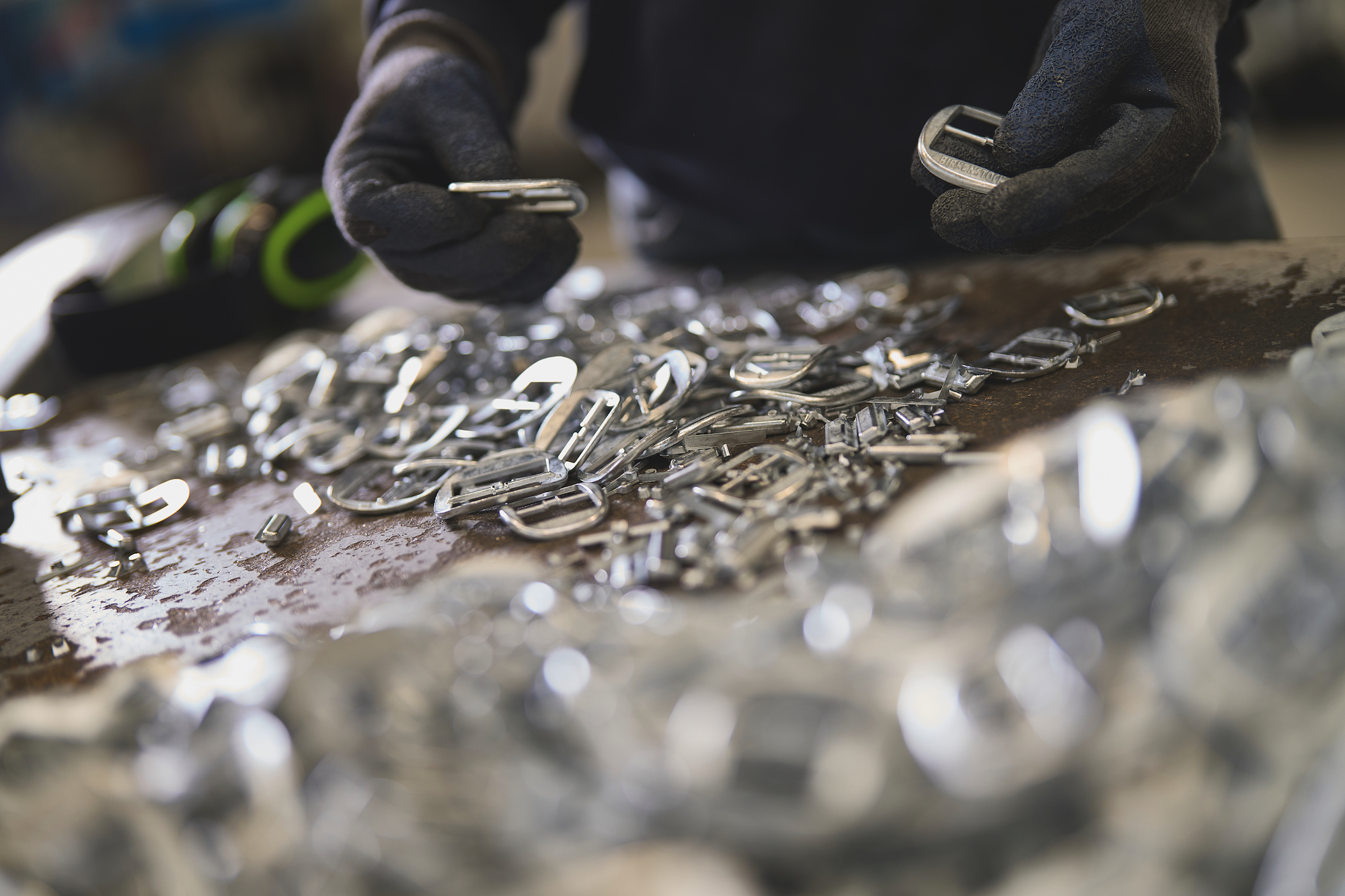
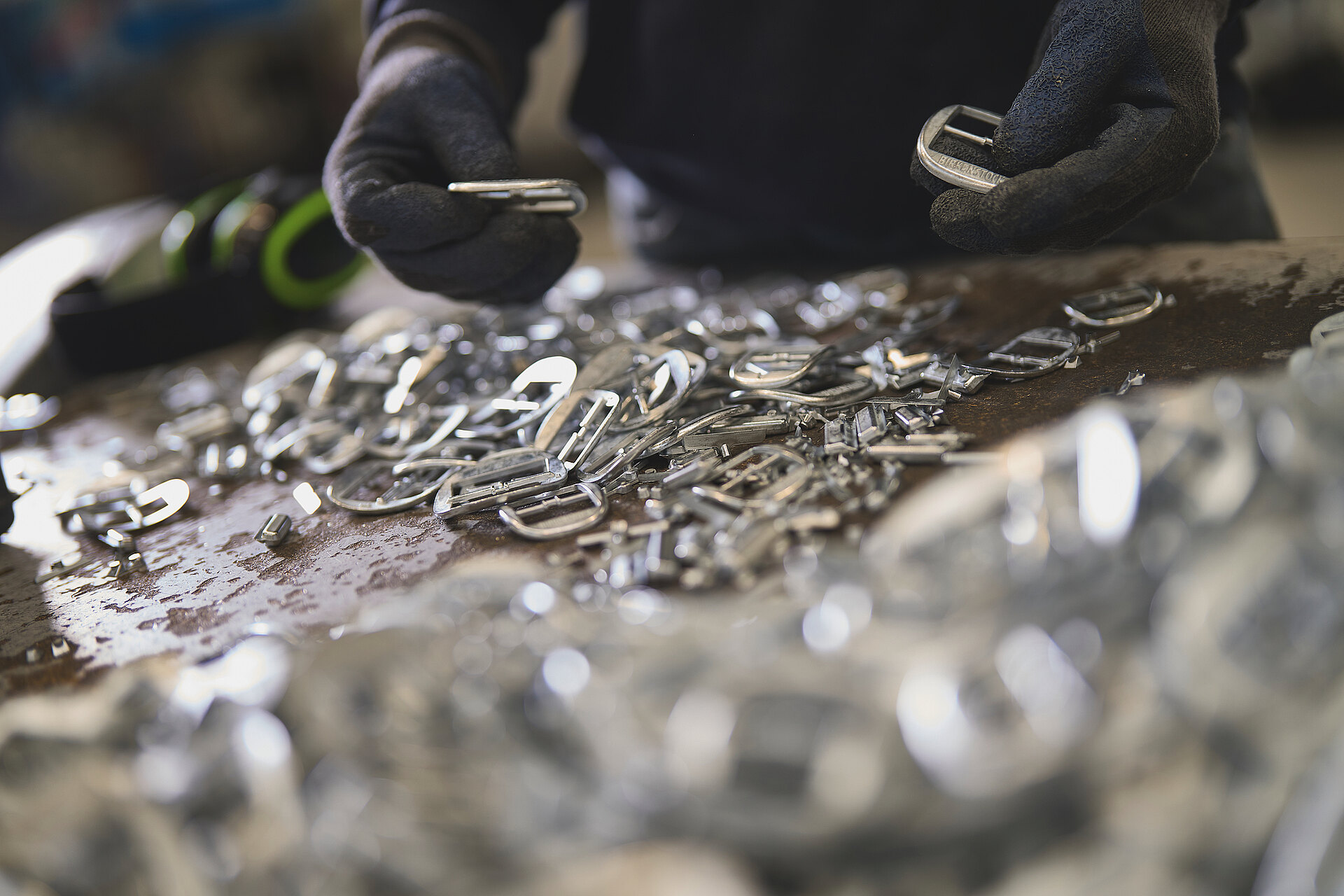
When they emerge from the press, they are still scorching – around 200°C. Once cooled, a skilled technician carefully removes the excess metal, known as “sprues,“ which may contain impurities or residue from the casting process. The buckles are then placed in a rotating barrel filled with grey resin cones, where they tumble for six to eight hours. This stage polishes the surface and removes any remaining imperfections, commonly referred to as “burrs,” preparing the pieces for the next phase: plating.
The buckles are then loaded into plastic barrels and immersed in a series of baths – some containing copper, others brass or white bronze. For our gold finish, each buckle spends between one and one and a half hours in each bath, where an electric current is applied to bond the metal layers to the surface. Once the plating is completed, the pieces are collected and transferred to another vibrating drum filled with sand, where they are gently dried. The time has now come to coat them.
This phase is particularly labor-intensive. In a large workshop, several women meticulously align the buckles on metal trays. For the 30 mm models, 99 fit on a single tray; the 40 mm versions accommodate just 64. Depending on the setup, either a specialist or a robot sprays the buckles with a protective coating to achieve the desired finish. This step takes place in enclosed rooms due to the intensity of the paint fumes. Behind the trays, a water curtain system captures up to 98% of airborne paint and varnish particles, ensuring a cleaner and safer workspace. Once dry, each buckle is flipped by hand on its tray and coated a second time. The prongs, made of brass – a more malleable material than Zamak – are then manually inserted using a tool that resembles a wall-mounted corkscrew. An skilled worker can assemble up to 400 pieces per hour.
For our most elaborate buckles, additional production stages are required. To see how our pearl buckles come to life, we leave Festina Lente and drive a few minutes to Fenili. Tucked into a small industrial zone northwest of Bergamo, this facility employs around 70 people.
Inside the hall where buttons are made, the sharp scent of burnt horn hangs in the air. Machines hum at full speed. In a quieter room nearby, 3-millimeter-thick acrylic sheets – decorated to resemble mother-of-pearl – are stacked in a neat pile. A high-precision laser cuts 200 perfect rectangles from each sheet, accurate to the micron. These are then thermoformed into delicate dome shapes using a compressed air press. A second laser gives each dome its final contour, and a final beam engraves our logo onto the surface. The pieces are then hand-polished before spending the night in a tumbler to achieve their glossy finish. Finally, the inserts are carefully glued and clipped by hand onto the metal buckles, giving them their signature pearl-like shimmer. Each finished buckle undergoes a rigorous quality check before being carefully packed into cardboard boxes. These are then stacked on pallets and shipped to our production sites in Markersdorf and Bernstadt.
Our Big Buckles perfectly complement our suppliers‘ impressive catalog. At Metalworks, visitors are welcomed by a striking black staircase that leads to a room showcasing every model the company has ever produced. At Fenili, the archives are preserved in massive wooden cabinets reminiscent of those found in old countryside homes. Inside, thousands of buckles, buttons, and brooches are meticulously catalogued – each one secured with hand-stitched threads onto brown cardboard sheets and stored in thick linen binders.
“You’re looking at more than a century of our company’s history,” says Mara Mangili, Senior Account Manager at Bottonificio Fenili. “In 2024, ten of your designers came to see us and spent hours diving into our vintage models. I’d love to host visits like that every year. These creative exchanges often spark new ideas, like the pearl buckle, which has become quite a hit. In the meantime, we keep developing new designs, like this hammered metal buckle, or this transparent version filled with cork granules. None have been selected so far, but who knows, maybe one day.”
In the Button Valley, companies build their archives not just to preserve the past, but to celebrate it. A way of fueling the future through memory. Sound familiar?